Your House Could Burn Down Tomorrow. The Biggest Mistake Wouldn’t Be The Fire.
It would be the paperwork.
Seriously.
Most homeowners think the hard part is making an insurance claim.
It isn’t.
The hard part is discovering you’ve insured your home for the wrong amount…
…after it’s no longer standing.
By then, the argument isn’t about whether your house burned down.
It’s about who pays the hundreds of thousands of pounds needed to rebuild it.
And that’s exactly why reinstatement cost matters.
Let’s Clear Up The Biggest Myth
People often assume this:
House Value = Reinstatement Cost
It makes sense.
They’re both big numbers.
They’re both related to your property.
Surely they’re the same?
Not even close.
Imagine your house is worth £900,000.
Sounds expensive.
But what if £500,000 of that is simply because it’s in Richmond instead of Rotherham?
Land has value.
Postcodes have value.
Schools have value.
None of those things need rebuilding after a fire.
Your insurer only cares about rebuilding the actual house.
So… What Is A Reinstatement Cost?
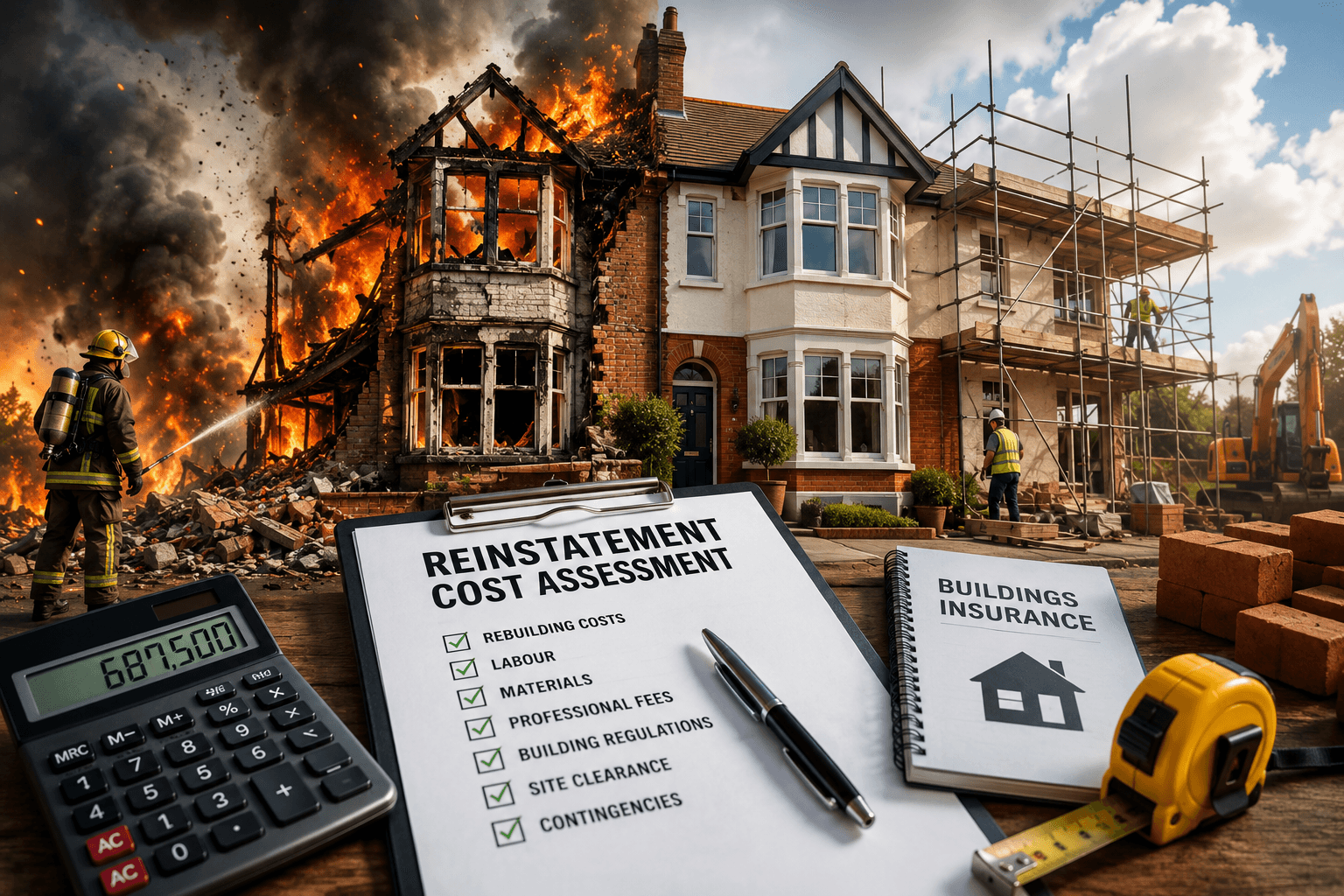
A reinstatement cost is the estimated cost of rebuilding your property after it’s been completely destroyed.
That includes things like:
- Demolition and site clearance
- Labour
- Building materials
- Professional fees
- Compliance with current Building Regulations
- Reconstructing the property as it stood before the loss
Notice what’s missing?
The land.
You don’t have to rebuild the land.
That bit usually survives.
Why Guessing Is A Terrible Idea
People guess their reinstatement cost all the time.
Sometimes they use the purchase price.
Sometimes they ask Google.
Sometimes they type a random number into their insurance application because…
…well…
…it asked.
That’s a bit like guessing your blood type on a medical form.
You might get lucky.
Or you might discover the mistake at exactly the wrong moment.
The Cheapest Insurance Isn’t Always The Cheapest
Insurance companies love accurate information.
They dislike surprises.
If your reinstatement cost is too low, you could be underinsured.
That means when disaster strikes, your payout may not cover the full cost of rebuilding.
Imagine needing £600,000 to rebuild your home…
…only to discover you’ve insured it for £400,000.
That’s not a small admin error.
That’s potentially life-changing.
Bigger Isn’t Always Better Either
Now let’s flip the problem.
Some people think,
“I’ll just insure it for a million pounds to be safe.”
Nice idea.
Unfortunately, insurers don’t usually hand out bonus money because you guessed high.
You could simply end up paying higher premiums than necessary.
More money.
No extra benefit.
Not ideal.
Building Costs Change. Quickly.
Remember when timber prices shot up?
Or when construction labour became harder to find?
Rebuilding costs aren’t fixed.
They’re affected by:
- Material prices
- Labour costs
- Inflation
- Building regulations
- Supply chain issues
That’s why a reinstatement cost shouldn’t be something you calculate once and forget about forever.
Older Homes Can Cost More To Rebuild
Here’s another surprise.
An older property isn’t always cheaper to reconstruct.
In fact…
It can be significantly more expensive.
Why?
Because rebuilding period features isn’t easy.
Think about:
- Handmade bricks
- Decorative stonework
- Timber framing
- Ornate plasterwork
- Traditional roofing materials
Finding someone who can recreate Victorian craftsmanship is considerably harder than ordering modern plasterboard.
Listed Buildings Are In A League Of Their Own
If you own a listed building…
Congratulations.
You own a beautiful piece of history.
You also own one of the most expensive types of property to rebuild.
Historic materials.
Traditional construction methods.
Conservation requirements.
Specialist contractors.
Everything becomes more complicated.
Which usually means…
More expensive.
When Do You Need A Reinstatement Cost Assessment?
More often than people realise.
You may need one when:
- Arranging or renewing buildings insurance.
- Buying a high-value property.
- Owning a listed or period home.
- Extending or significantly altering your property.
- Managing commercial property.
- Reviewing insurance after major building works.
If your property has changed…
Your reinstatement cost probably has too.
Can An Online Calculator Replace A Professional Assessment?
Sometimes they’ll get you in the right ballpark.
Sometimes they won’t.
Online calculators usually rely on averages.
Properties rarely do.
A bespoke architect-designed house…
A listed cottage…
A converted barn…
A luxury flat…
These aren’t average properties.
And average assumptions can produce very average mistakes.
Why Use A Chartered Surveyor?
A professional reinstatement cost assessment is based on the actual property, not a generic estimate.
A RICS Chartered Surveyor considers factors such as:
- Construction type
- Size and layout
- Quality of materials
- Age of the building
- Complexity of the design
- Specialist features
- Current rebuilding costs
The result is a more reliable figure for insurance purposes.
And when you’re insuring one of the biggest assets you’ll ever own…
Reliable is exactly what you want.
Nobody plans for their home to burn down.
Nobody plans for a major flood.
Nobody plans for a gas explosion.
Insurance exists because unexpected things happen.
But insurance is only as good as the number it’s based on.
If that number is wrong…
Everything else starts to unravel.
A professional reinstatement cost assessment gives you confidence that, if the worst ever happened, your insurance reflects the true cost of rebuilding your home not a guess made in five minutes over a cup of tea.
Need a Professional Reinstatement Cost Assessment?
At Sterlingworth Surveyors, our RICS Chartered Surveyors provide reinstatement cost assessments for residential and commercial properties.
Whether you’re arranging buildings insurance, reviewing your cover, or have recently extended your property, we’ll provide an independent assessment based on your property’s actual construction and current rebuilding costs.
Protect your property with a professional reinstatement cost assessment.