
A residual valuation works out what a development site is worth by starting with the value of the finished scheme and deducting everything needed to deliver it: build costs, fees, finance and the developer’s profit. What is left is the residual land value. We prepare residual valuations and development appraisals for developers, landowners, investors and lenders deciding whether to buy, sell, fund or promote a site.
Sterlingworth Surveyors is an RICS-regulated firm, and every development valuation shows its evidence and inputs in full.
A residual valuation is a method of valuing land or buildings with development potential. The valuer estimates the gross development value (GDV) of the completed scheme, deducts the full cost of delivering it, including the developer’s profit, and treats what remains as the value of the land. It is widely used where there is little direct evidence from sales of comparable sites.
The method is also called a residual appraisal or residual land valuation.

Residual land value is calculated by taking the gross development value of the completed scheme and deducting the development costs and the developer’s profit. In its simplest form:
Gross development value (GDV) less development costs less developer’s profit = residual land value
Development costs include construction, professional fees, planning obligations, finance, sales costs, a contingency and the costs of buying the land.
The calculation is simple; the judgement lies in the inputs. Because the land value is what is left after large deductions, a small change in sales values or build costs can make a much bigger proportional difference to the residual. That is why a credible residual valuation shows its assumptions and tests them.
This explains the method only. It is not investment advice, and every scheme needs its own appraisal.

Gross development value is the expected value of the completed development: the combined sale prices of the finished units or, where space will be let, the capitalised value of the rents. As the starting point of the appraisal, it must be supported by comparable sales and lettings evidence.
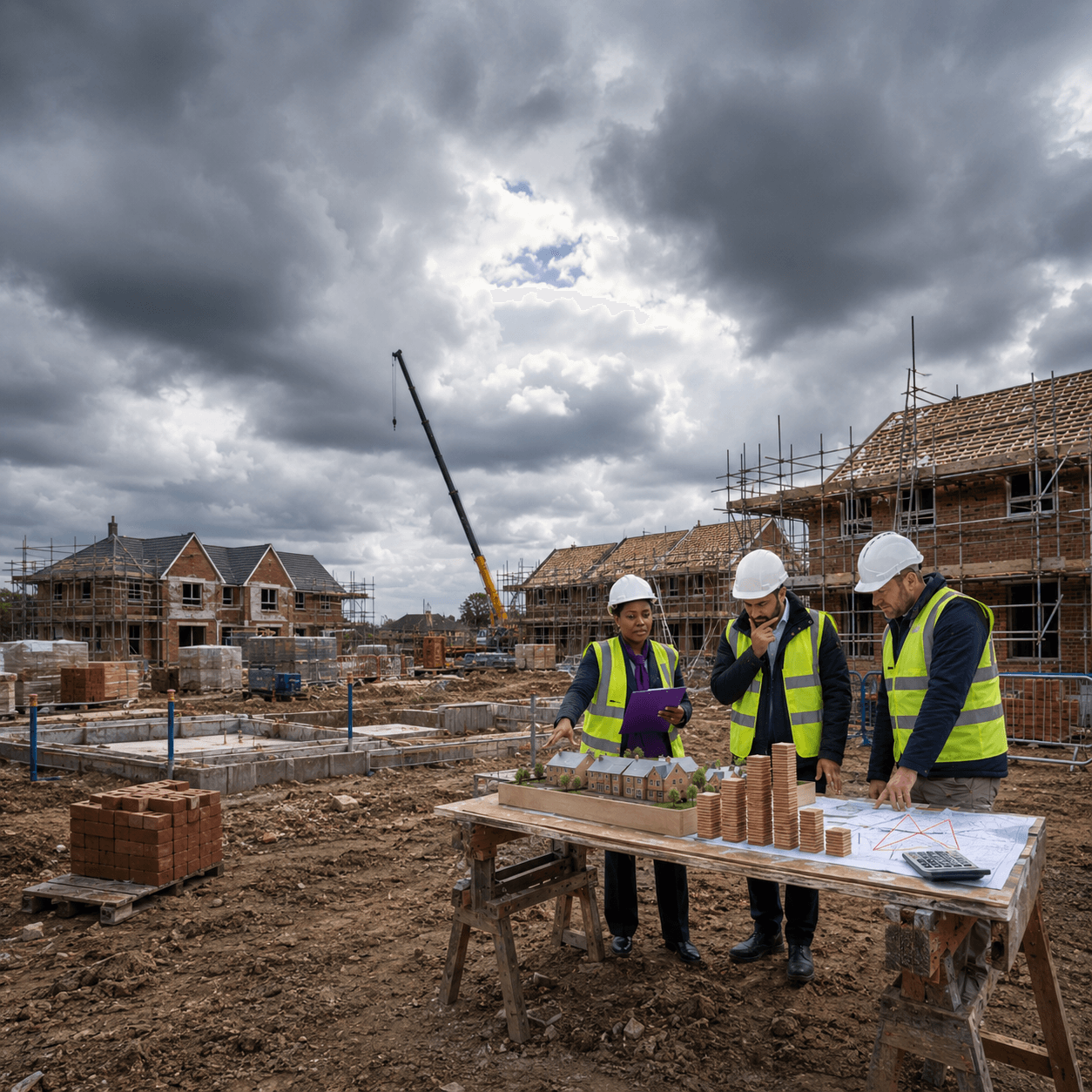
Everything a developer would pay to take the site from bare land to a completed, sold or let scheme:
| Input | What it covers | Evidence used |
|---|---|---|
| Build costs | Construction, demolition, site preparation, external works and a contingency | The scheme's cost plan, or benchmark build cost data |
| Professional fees | Architects, engineers, planning consultants and other advisers | Scheme-specific quotes or market allowances |
| Planning obligations | Section 106 contributions, affordable housing and the Community Infrastructure Levy (CIL) where charged | The planning permission, heads of terms and the local charging schedule |
| Finance | Interest and fees on borrowing for land and construction | Current lending terms and the cash flow |
| Sales and acquisition costs | Agents' and legal fees on selling the units and buying the land, and any tax on the purchase | Market practice and the acquisition terms |
| Developer's profit | The return needed to take on the scheme's risk | Comparable schemes, usually a percentage of GDV or of cost |
| Timing | Pre-construction period, build programme, phasing and sales period | The proposed programme and likely rate of sales |
As a cost of the scheme, because no developer would take on the risk without it. The level reflects that risk: planning uncertainty, a long programme or an untested market usually call for a higher return.
You need a development valuation whenever a decision depends on what a site with development potential is worth, or whether a scheme will work financially. Common reasons include:
As early as possible, before an offer is made or a planning strategy is settled, and then updated as the scheme develops.
Each instruction is scoped to the decision you need to make, and typically includes:
Residual land value calculated from gross development value and total development costs, with every key assumption stated.
Whether the scheme is viable on the proposed terms, including the profit it produces where the land price is known.
Comparable schemes, sales and lettings evidence and demand, supporting the values and rents used.
A structured appraisal of costs, values, finance, timing and returns, with a cash flow where needed.
How changes in values, costs or timing affect the outcome.
Market Value is the estimated amount a property should sell for on the valuation date between a willing buyer and a willing seller, after proper marketing. Residual value is a way of arriving at the value of development land by working back from the completed scheme.
| Market Value | Residual land value | |
|---|---|---|
| What it measures | What a property should achieve on the open market on the valuation date | What land could be worth for a particular scheme, once completed value, costs and profit are accounted for |
| Main evidence | Comparable sales and lettings | GDV, cost, finance and timing inputs, supported by comparable evidence |
| Typical uses | Buying, selling, lending, tax, legal and financial reporting | Development land, feasibility, funding and planning viability |
| Sensitivity | Moves with the market | Can change sharply with small changes in values or costs |
A residual figure is not automatically the Market Value: the valuer weighs it against other evidence. If you need the value of an existing property rather than a development site, see our residential property valuations or, for business and investment property, our commercial property valuation service.
In England, a residual appraisal is the usual way to show whether a proposed scheme can meet its planning obligations, such as affordable housing and Section 106 contributions, and still be delivered.
Government planning practice guidance compares the scheme’s residual land value with a benchmark land value, generally based on the existing use value of the land plus a premium for the landowner, rather than the price a developer has paid. Government guidance expects viability to be tested mainly when local plans are prepared, so a site-specific assessment at application stage needs to be justified, and the weight given to it is for the decision maker.
In viability work, our valuers act objectively and impartially.
The report sets out:
If anything is unclear, you can discuss it with the valuer.

Sensitivity analysis shows how far the residual land value moves when key inputs change. As the balance left after large deductions, the land value is the most exposed figure in the appraisal. A useful analysis tests:
Results are often shown as a matrix of land values across a range of sales values and build costs, which shows where the scheme stops working.
A residual valuation is not:
The fee depends on the site or scheme and on the service you need. Tell us about the project and we will confirm a fixed fee before you instruct us.
Reviewed by Phil Partridge MRICS, Registered Valuer (RICS number 0076569)
Last reviewed
Gross development value (GDV) is the expected value of the completed development once sold or let. It is the starting figure in a residual appraisal, so it must be supported by comparable market evidence.
Market Value reflects what a property should sell for on the open market. Residual value is the land value left after deducting development costs and profit from the projected completed value.
Yes. We provide feasibility analysis to test viability before you buy land or submit a planning application.
Yes. Residual valuations can be reviewed as costs, planning or market conditions change.
Yes. We can assess individual sites, multiple plots and phased schemes, depending on your instruction.
Yes. Our reports are prepared for lender and investor review, although lenders may have their own requirements, such as instructing the valuer directly.
We assess residential, commercial and mixed-use development projects.
Tell us about the site and the scheme, and we will confirm the scope and a fixed fee before you instruct us.


